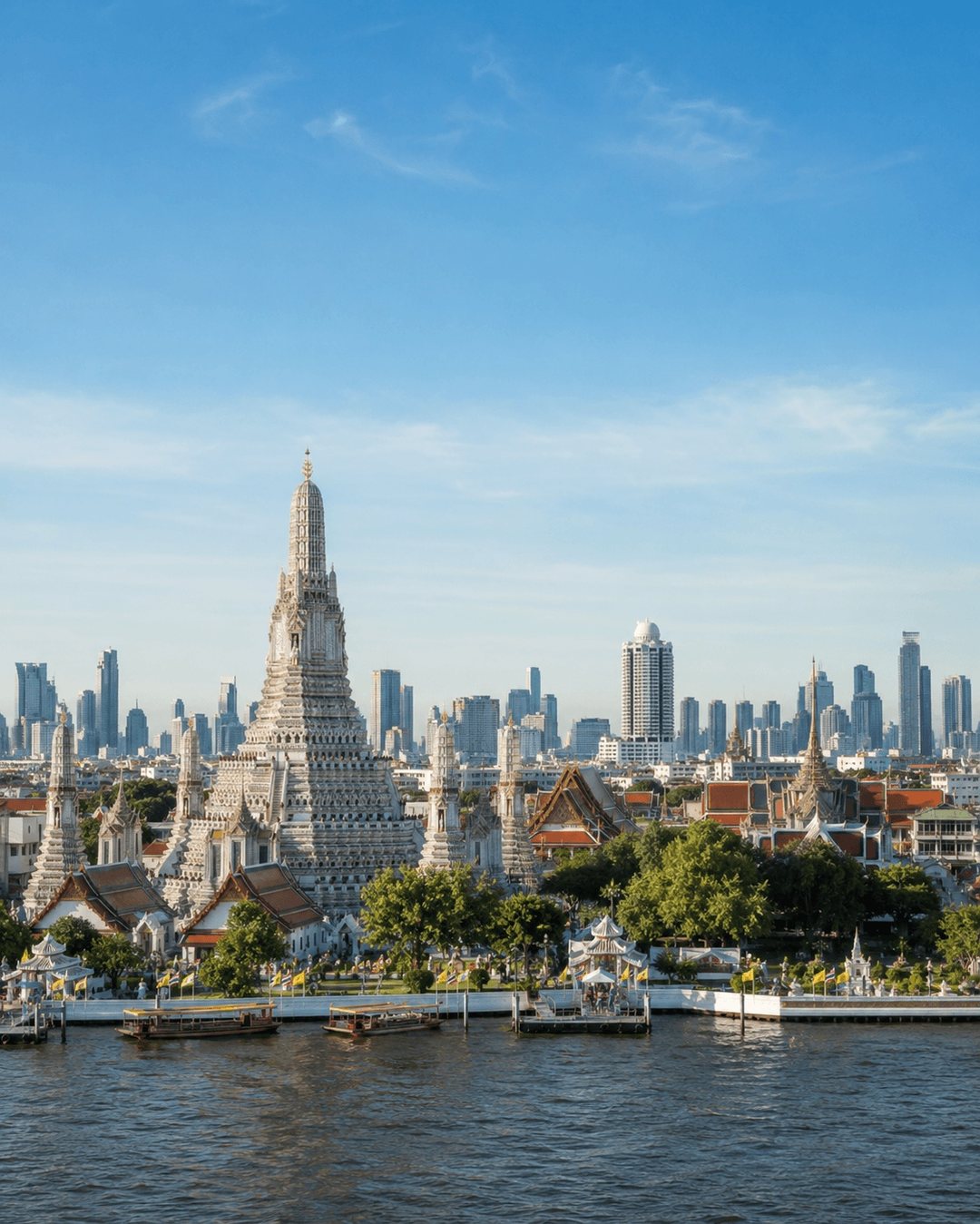
Bangkok at Full Heat: Where the City Finds Its Coolest Pauses
Three exceptional hotel records and three thrilling dining rooms shape a Bangkok itinerary built around river light, old streets, tropical afternoons and serious appetite.
Executive brief
Bangkok reveals its elegance through contrast: ceremony and improvisation, cold linen and street heat, exacting kitchens and a city that never asks permission to change the plan.
01Bangkok should feel abundant, never overfilled
Bangkok defeats itineraries that mistake intensity for speed. The city is already generous with sensation: temple roofs caught in morning light, engines and incense sharing the same air, a quiet courtyard behind a commercial street, dinner extending far beyond the hour printed in the calendar. Adding six major stops to every day merely dulls the traveller’s ability to notice any of them. Four nights work when mornings belong to the city, afternoons to recovery and evenings to appetite. The structure is not timid. It is a way of meeting tropical heat, traffic and ambitious dining at their natural scale. Begin early, stop before fatigue becomes irritability and return after dark, when Bangkok changes character and the day acquires a second life.
The reviewed addresses support that rhythm with unusual strength. Aman Nai Lert Bangkok carries an exceptional luxury distinction and published, The Siam follows at exceptional luxury and 96.9, while 137 Pillars Suites Bangkok holds a leading hotel record for the stated edition and 89.9. All three hotel records are led by convincing food and drink; Aman adds exceptional depth of service, while The Siam and 137 Pillars foreground restorative facilities. The dining rooms widen the register: Sühring has a leading restaurant record for the stated edition and published, Gaa a leading restaurant record for the stated edition and 96, and Sorn a leading restaurant record for the stated edition and 95. This is not a list to complete. One hotel becomes the base, two restaurants become commitments, and the remaining address becomes the reason another Bangkok visit already has a beginning.
Hotel
Aman Nai Lert Bangkok
Bangkok, ThailandA distinctive address in Bangkok, Thailand, defined above all by the depth of its service system and a convincing food-and-drink offer.
Open the record →Hotel
The Siam
Bangkok, ThailandThe Siam brings unusual clarity to a convincing food-and-drink offer while sustaining its restorative facilities.
Open the record →Hotel
137 Pillars Suites Bangkok
Bangkok, ThailandA distinctive address in Bangkok, Thailand, defined above all by a convincing food-and-drink offer and its restorative facilities.
Open the record →Restaurant
Sühring
Bangkok, ThailandSühring gives modern German cooking a convincing home in Bangkok by beginning with the twins Thomas and Mathias Sühring's own family memory.
Open the record →Restaurant
Gaa
Bangkok, ThailandGaa is Garima Arora's sustained inquiry into what Indian cooking can become when its techniques meet the produce and climate of Thailand.
Open the record →Restaurant
Sorn
Bangkok, ThailandSorn places Southern Thai traditions within a formal Bangkok setting without muting their intensity.
Open the record →02Three hotels, three versions of retreat
Aman Nai Lert Bangkok’s published exceptional luxury record is the choice for travellers who place service depth at the centre of luxury. Its reviewed food-and-drink strength also means the hotel can credibly carry an arrival evening or the meal between two destination reservations. The Siam, exceptional luxury at 96.9, makes an equally formidable case through food, drink and restorative facilities. It suits the guest who wants the hotel day to be part of the Bangkok experience rather than an intermission with no narrative of its own. 137 Pillars Suites Bangkok, a leading hotel record for the stated edition, is also led by dining and restoration, offering a high-scoring alternative when the trip requires a different scale or price logic. The distinctions are meaningful; they are not commands to book the largest number.
Before choosing, map the two reservations least likely to move and estimate travel at the actual hour they occur. Bangkok distance is measured in time, weather and transport options, not kilometres alone. The right hotel is the one that prevents every evening from beginning with anxiety. Ask about the property’s current transfer arrangements, room orientation, accessibility and the most sensible way to reach each dinner. Then use what has been paid for. A restorative proposition has little value when every afternoon is spent crossing town to tick off another sight. Returning for ninety minutes—a shower, a quiet drink, clothes changed without haste—can turn an oppressive day into an exhilarating night. In Bangkok, retreat is not withdrawal. It is the instrument that keeps curiosity intact.
Hotel
Aman Nai Lert Bangkok
Bangkok, ThailandA distinctive address in Bangkok, Thailand, defined above all by the depth of its service system and a convincing food-and-drink offer.
Open the record →Hotel
The Siam
Bangkok, ThailandThe Siam brings unusual clarity to a convincing food-and-drink offer while sustaining its restorative facilities.
Open the record →Hotel
137 Pillars Suites Bangkok
Bangkok, ThailandA distinctive address in Bangkok, Thailand, defined above all by a convincing food-and-drink offer and its restorative facilities.
Open the record →Bangkok’s most persuasive luxury is the cool, composed pause that sends the traveller back into the city more alert than before.
The World’s Best Travel Desk
03Old Bangkok belongs to the clear, cooler hours
Place the historic core on the first full morning, when jet lag can be converted into an early start. Dress for sacred spaces with shoulders and knees covered, carry water and choose fewer sites than the map appears to permit. Wat Phra Kaew, Wat Pho, Wat Arun and the Golden Mountain are not interchangeable ornaments; each deserves enough time for architecture, ritual life and surrounding streets to register. Confirm current opening information through official channels, arrive before the largest groups where possible and hire a knowledgeable guide if historical context matters more than collecting photographs. The guide’s value is not privileged access to every doorway but the ability to establish sequence, etiquette and meaning while the day is still cool enough for attention.
Leave by early afternoon without forcing lunch and another monument into the hottest part of the day. A boat or rail segment can be more revealing than a sealed car when it fits the route, but comfort should not be performed as a virtue; take the air-conditioned transfer when heat has begun to erase pleasure. Lunch can remain simple and close to the morning’s final stop. Food safety is best approached through turnover, cleanliness and informed local advice rather than fear of everything informal. Back at the hotel, protect the pause. Restorative facilities lead the records at The Siam and 137 Pillars, and Aman’s depth of service can make complicated transitions disappear. This is precisely the hour when those strengths become more valuable than another pin on a digital map.
04Sorn turns Southern Thai force into the evening’s single purpose
Sorn holds a leading restaurant record for the stated edition and published for Southern Thai cooking presented in a formal Bangkok setting without muting its intensity. That final phrase matters. The dinner is not a softened introduction designed to reassure a luxury audience; it is an argument that heat, fermentation, seafood, spice and regional memory deserve full attention within an exacting service framework. Reserve well ahead, disclose allergies with precision and never assume that a general preference for ‘mild’ can be accommodated without changing the cuisine’s intended balance. The most respectful approach is honest conversation before the evening, followed by trust. Keep lunch restrained and avoid a late-afternoon tasting, tea or cocktail ritual that steals appetite from the reservation that was hardest to secure.
Dress with polish but also with Bangkok’s climate in mind, and allow an unhurried transfer. Arriving flustered after a day spent proving endurance is the wrong prologue to a menu built on concentration. Once seated, let the sequence establish its own cadence. A formal room can amplify the cuisine’s precision without taming its identity; that tension is what distinguishes the restaurant in this edit. Afterwards, return directly to the hotel unless energy genuinely suggests otherwise. The night does not need a rooftop coda merely because Bangkok has one available. Sorn should remain a complete evening, its flavours clear enough the next morning to influence breakfast. In a city of infinite options, restraint is what allows an exceptional meal to remain singular.
05Gaa and Sühring show how international Bangkok has become local
Gaa’s Three-restaurant records, published record centres on chef Garima Arora’s inquiry into Indian technique meeting Thai produce and climate. It is a Bangkok restaurant in the deepest sense: not because the menu must stay inside a national category, but because the city’s ingredients, weather and openness give the cooking its conditions. Approach it after a day weighted toward contemporary Bangkok—design, galleries, independent shops or simply the neighbourhoods that reveal how the city lives beyond its monuments. Keep the afternoon light and give the dinner enough mental space. The intellectual premise is compelling, yet the restaurant should still be experienced through appetite, texture and pleasure rather than treated as a lecture whose references must all be decoded.
Sühring, reviewed a leading restaurant record for the stated edition, offers a strikingly different finale. Its modern German cooking is grounded in the twin chefs’ family memory, giving Bangkok another cosmopolitan restaurant that gains authority through specificity, not fashionable vagueness. Choose Sühring when the trip needs contrast after several days of Thai and regionally connected meals; choose Gaa when culinary exchange itself is the subject of the evening. Attempting both on consecutive nights can flatten their distinction, so separate them with an informal dinner or place one on a future itinerary. Each deserves punctual arrival, early dietary communication and a day that does not compete for attention. The luxury lies in hearing two clear voices, not in accumulating reservations at the highest possible rate.
Restaurant
Gaa
Bangkok, ThailandGaa is Garima Arora's sustained inquiry into what Indian cooking can become when its techniques meet the produce and climate of Thailand.
Open the record →Restaurant
Sühring
Bangkok, ThailandSühring gives modern German cooking a convincing home in Bangkok by beginning with the twins Thomas and Mathias Sühring's own family memory.
Open the record →06Move by system, not by reflex
Bangkok transport becomes manageable once no single mode is expected to solve the entire city. Rail is efficient for districts it directly serves and avoids the uncertainty of road traffic. Boats can turn river movement into part of the experience when piers and schedules align. Taxis or hotel cars remain useful for door-to-door journeys, formal evenings and routes poorly connected by rail. Check the official BTS information for current routes and timetables, ask hotel staff to compare options at the time of travel and leave generous margins for dinner. The least elegant Bangkok moment is not public transport; it is a beautiful car stopped indefinitely while the reservation clock advances. Practical intelligence is more luxurious than loyalty to any one method.
Carry the hotel address in Thai, keep a charged phone and store an offline copy of essential confirmations. Small notes are useful, as is a payment alternative when a terminal or app does not cooperate. During temple days, wear shoes that are easy to remove and clothing that remains respectful without becoming punishing in the heat. Afternoon storms can be sudden, so a compact umbrella and a hotel plan that does not collapse when rain arrives are worth more than another formal outfit. Air quality and weather vary; check reliable local information each morning. None of this requires overplanning. It simply removes the minor frictions that otherwise multiply until a traveller begins blaming the city for a schedule that never respected its conditions.
07Bangkok’s coda begins when the heat releases the streets
Bangkok changes register in the hour when the pavement cools and evening commerce gathers momentum. Reserve one night to experience that release without a formal agenda. A short rail journey, a boat crossing when schedules suit, a market reached after dark or an unceremonious supper can restore proportion after the concentration of Sorn, Gaa or Sühring. The meal need not interpret the city. It can be direct, social and brief enough for the surrounding streets to remain part of it. Tropical air, engine noise and the sudden calm behind a doorway form a Bangkok composition no tasting menu should be asked to replace.
Aman Nai Lert Bangkok, The Siam and 137 Pillars Suites Bangkok make the necessary counterpoint through service, dining and restoration. Their calm matters because the city outside is so fully alive; the city matters because calm without contrast would be merely comfortable. The editorial reviews clarify the properties’ strengths and the restaurants’ authorship, but Bangkok gives those judgments temperature, sound and speed. End with that alternation intact: street and sanctuary, spice and cool water, movement and stillness. It is the rhythm that makes four nights feel substantial without making them feel contained.
Hotel
Aman Nai Lert Bangkok
Bangkok, ThailandA distinctive address in Bangkok, Thailand, defined above all by the depth of its service system and a convincing food-and-drink offer.
Open the record →Hotel
The Siam
Bangkok, ThailandThe Siam brings unusual clarity to a convincing food-and-drink offer while sustaining its restorative facilities.
Open the record →Hotel
137 Pillars Suites Bangkok
Bangkok, ThailandA distinctive address in Bangkok, Thailand, defined above all by a convincing food-and-drink offer and its restorative facilities.
Open the record →Restaurant
Sühring
Bangkok, ThailandSühring gives modern German cooking a convincing home in Bangkok by beginning with the twins Thomas and Mathias Sühring's own family memory.
Open the record →Restaurant
Gaa
Bangkok, ThailandGaa is Garima Arora's sustained inquiry into what Indian cooking can become when its techniques meet the produce and climate of Thailand.
Open the record →Restaurant
Sorn
Bangkok, ThailandSorn places Southern Thai traditions within a formal Bangkok setting without muting their intensity.
Open the record →