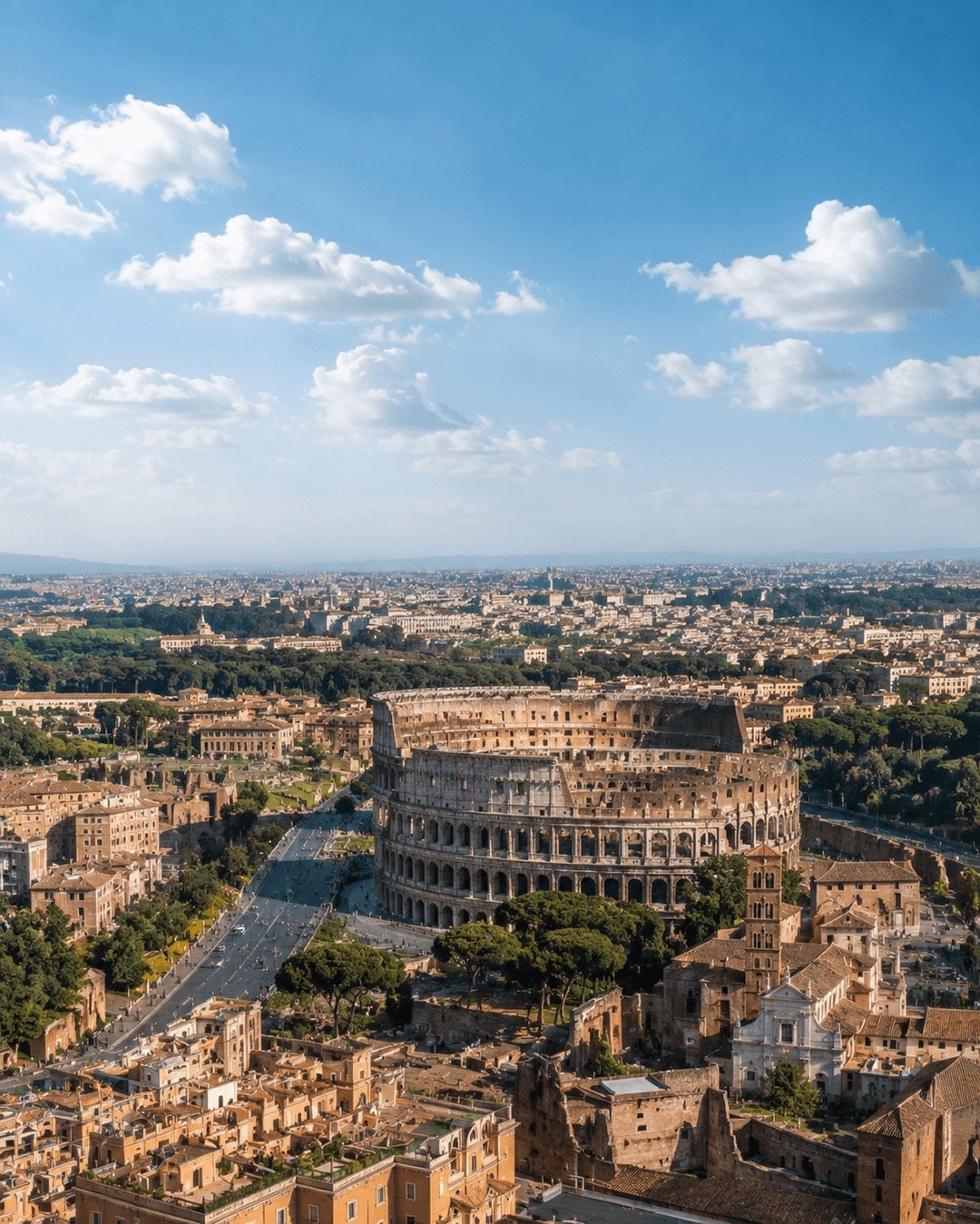
Italy’s Grand Tour Is Back—and These Hotels Make It Irresistible
From Roman baths and a rooftop dining room to two extraordinary Amalfi Coast hotels, a Florentine hillside retreat, Piedmont produce and a Venetian palazzo, this is Italy with time left in the frame.
Executive brief
A four-part journey through Rome, the Amalfi Coast, Florence and Venice, with strategic detours for three of Italy’s most distinctive Three-restaurant records tables.
01A grand tour needs room between the icons
Italy is the country most likely to turn a well-intentioned traveller into a collector. Rome, Florence and Venice are placed in a line; the Amalfi Coast is inserted because it seems impossible to omit; meals become reservations around which monuments are stacked. The result can be impressive and strangely airless. A better grand tour treats the journey as composition. Cities provide density, the coast opens the frame, countryside resets the palate and the hotels are chosen for how they control the transition between each act.
The eight addresses here come from the 2026 reviewed record and support that more spacious approach. Six Senses Rome introduces the capital through restoration and service. Monastero Santa Rosa and Borgo Santandrea interpret the same Amalfi cliffs in distinct ways. Collegio alla Querce creates distance above Florence, while Il Palazzo Experimental offers a more intimate, contemporary Venice. La Pergola, Reale and Piazza Duomo each hold a leading restaurant record for the stated edition, but their authority comes from very different kinds of Italian authorship.
This is not a claim that these are the only essential places in Italy. It is a route with an argument: begin with urban history, move toward sea and silence, then return to art, gardens and the cultivated north before ending in a city that makes arrival itself ceremonial. The itinerary should take at least sixteen nights and ideally three weeks. Any shorter version must omit a chapter rather than compress all of them.
Travel by train where the line is direct and use a driver when geography becomes part of the experience. The road toward the Amalfi Coast, the inland journey to Castel di Sangro and the movement through Piedmont need not be dead time. They allow landscape to explain changes in architecture and food. Italy’s luxury is not just inside the reviewed addresses; it is in the continuity between them when the route is given enough time to become legible.
Hotel
Six Senses Rome
Rome, ItalyA considered stay in Rome, Italy, led by the depth of its service system and a convincing food-and-drink offer.
Open the record →Hotel
Monastero Santa Rosa
Conca dei Marini, ItalyThe case for Monastero Santa Rosa begins with the depth of its service system and holds through a convincing food-and-drink offer.
Open the record →02Rome: begin with restoration, then dine above the city
Six Senses Rome is a fitting first address because its proposition is about restoring equilibrium in the middle of a city that can overwhelm even the most enthusiastic visitor. The hotel’s exceptional luxury distinction is led by service and dining, with wellbeing close to the centre of its identity. That combination allows Rome to remain vivid without becoming exhausting: mornings can begin early, afternoons can contract into the hotel, and evenings can expand again after the heat and crowds have softened.
Give the city four nights. Choose one major ancient site, one church or palazzo and one long neighbourhood walk each day; anything more risks turning layers into noise. Rome rewards lateral attention—the worn threshold, the small fountain, the sudden view through a courtyard—as much as scheduled access. The hotel should act as an editor, helping guests decide which reservations are truly time-sensitive and which experiences are improved by spontaneity.
La Pergola provides the formal counterpoint. The Three-restaurant records restaurant is distinguished in our record by the value of long authorship that remains open to revision. That phrase matters in Rome, where tradition can become either a living material or a shield against change. Plan the dinner as the day’s principal event. Eat lightly at lunch, return to the hotel before dressing and allow the meal’s pacing and city view to carry the evening rather than attaching another bar or spectacle afterward.
Rome is also where the route establishes its governing rule: do not confuse abundance with completeness. The capital will always leave important things unseen. A luxurious visit accepts that fact. By the fourth morning, familiarity should have begun to replace urgency—the same café, a preferred walk, recognition at the hotel. Leave then, not because Rome is finished, but because the journey has acquired a rhythm worth protecting.
Hotel
Six Senses Rome
Rome, ItalyA considered stay in Rome, Italy, led by the depth of its service system and a convincing food-and-drink offer.
Open the record →Restaurant
La Pergola
Rome, ItalyLa Pergola shows what long authorship can achieve when it remains open to revision.
Open the record →Italy becomes more luxurious when the itinerary stops collecting masterpieces and starts allowing places to alter the pace of the journey.
The World’s Best Travel Desk
03The Amalfi Coast: two hotels, two perspectives
Monastero Santa Rosa and Borgo Santandrea share Conca dei Marini, yet the experience of staying at each is meaningfully different. Monastero Santa Rosa occupies the former life and contemplative scale of a monastery high above the water. Its 2026 exceptional luxuryeditorial record leads the entire reviewed hotel directory, supported by a complete service system, dining and wellbeing. Borgo Santandrea descends toward the sea with a more mid-century, beach-oriented glamour, its distinction led by food and restoration.
Choose Monastero when privacy, silence and the drama of looking down the coast are the main desires. The small room count in the reviewed record reinforces the sense that common spaces can remain composed even when the season is busy. A cliffside hotel of this kind should not be treated merely as a base for day trips. The terrace, gardens, spa and changing light are the itinerary. One carefully chosen outing is enough to give the wider coast context.
Choose Borgo Santandrea when direct contact with the water matters more. Its perspective is lower, brighter and more social. Lunch, a swim and the return to a shaded room can structure the day without the formality of constant departure. The hotel makes particular sense for travellers who love the Amalfi Coast but dislike the feeling of being held at a scenic distance from the sea.
The ideal solution, for a longer journey, is to split six nights between them. Three nights above the coast at Monastero, followed by three closer to the water at Borgo, turn a short transfer into a genuine change of scene. This is an indulgence, but a purposeful one: two hotels reveal the cliffs vertically. The contrast keeps the destination fresh without requiring another town, another flight or another country.
Hotel
Monastero Santa Rosa
Conca dei Marini, ItalyThe case for Monastero Santa Rosa begins with the depth of its service system and holds through a convincing food-and-drink offer.
Open the record →Hotel
Borgo Santandrea
Conca dei Marini, ItalyIn Conca dei Marini, Italy, Borgo Santandrea is distinguished by a convincing food-and-drink offer and its restorative facilities.
Open the record →04The inland detour: Reale and the discipline of clarity
Reale in Castel di Sangro is not on the most efficient line between the Amalfi Coast and Florence, which is precisely why it belongs in a serious culinary itinerary. Niko Romito’s Three-restaurant records restaurant reduces modern Italian cooking toward clarity, structure and essential flavour. The journey inland strips away the coastal image of Italy and replaces it with a more austere landscape, preparing the palate for a cuisine built on concentration rather than abundance.
Treat the restaurant as an overnight destination. A long tasting menu followed by a late drive would turn care into endurance. Arrive with daylight, let the surroundings reset the eye and keep the hours before dinner nearly empty. Reale’s authority depends on attention to transformations that may appear visually spare but are technically and conceptually dense. Hunger is necessary; so is mental quiet.
The restaurant’s appeal within this route lies in disagreement. After Rome’s historical density and Amalfi’s sensual immediacy, Reale asks what remains when an ingredient is subjected to rigorous editing. It demonstrates that Italian generosity need not always take the form of visible profusion. Precision can be generous when it makes flavour clearer, and restraint can feel luxurious when the traveller has spent days surrounded by spectacle.
If time does not allow the detour, omit it cleanly rather than squeezing it between checkout and a northbound train. The itinerary remains strong. But for travellers who organize journeys around restaurants, Reale is the moment that shifts the grand tour from beautiful sequence to culinary argument. It changes the way later meals are read, especially in Florence and Piedmont, where garden, produce and landscape return in different forms.
05Florence: choose a hillside pause over a crowded centre
Collegio alla Querce, Auberge Collection, offers Florence with a degree of separation. The 2026 exceptional luxury record leads with dining and wellbeing, supported by service, which suits a former educational complex turned hillside retreat. Staying above the city changes the daily pattern: descend with purpose, spend several concentrated hours among museums and streets, then withdraw before cultural appetite becomes fatigue.
Four nights allows Florence to be both destination and pause. Reserve the most important museum entry for the first full morning, when attention is sharp. Give another day to walking between churches, workshops and a long lunch. Keep the third flexible for a garden, an artisan visit or simply more time at the hotel. The city is compact enough to encourage overbooking; the hillside location introduces useful resistance.
The hotel’s food-and-drink strength matters because dinner need not always require another descent. One of the pleasures of a resort-like city hotel is the ability to let an evening remain contained without feeling compromised. After days of formal dining, a calm terrace, well-paced service and a view that places Florence at a slight distance can be more memorable than another famous room reached through traffic.
This is also the point to reduce luggage, reset sleep and reassess the final chapter. A grand tour should improve as it proceeds, not merely accumulate. Collegio alla Querce works as a hinge because it keeps the culture of Florence close while restoring the physical ease of the Amalfi stay. By departure, the traveller should feel curious again rather than accomplished.
06Piedmont: Piazza Duomo and the garden as composition
Piazza Duomo in Alba is the northern culinary detour worth protecting. Its Three-restaurant records distinction rests on a clear idea: the garden is not a sourcing footnote but a source of composition. In a region internationally associated with powerful wines, truffles and rich culinary tradition, the restaurant’s plant-led intelligence brings another kind of depth—one that is visual, seasonal and rooted in cultivation.
Plan at least two nights in Piedmont. Arrive early enough to see the landscape rather than only the dining room, and avoid placing another ambitious tasting menu on the adjacent evening. A winery visit, a village walk and a simple regional lunch will give Piazza Duomo’s refinements a more resonant context. Fine dining becomes more intelligible when the traveller has encountered the ingredients and terrain outside the formal sequence.
Alba also offers a useful transition between Florence and Venice. The hills slow the journey once more before the final city, and the restaurant extends the route’s conversation between restraint and abundance. At Reale, editing creates clarity; at Piazza Duomo, cultivation creates range. Both are contemporary, but neither abandons the conditions of its place.
Season will affect the mood dramatically. Autumn brings intense demand and the famous magnetism of truffle season; other months allow the garden and wider region to speak without that single ingredient dominating the narrative. Choose according to appetite and tolerance for crowds. The restaurant’s core proposition is broader than one celebrated product, and a quieter visit may reveal that breadth more clearly.
07Venice: end where every arrival is by water
Il Palazzo Experimental is an intimate final address in Dorsoduro, away from the most congested axes yet unmistakably Venetian. Its exceptional luxury distinction is led by service and dining, with the completeness of the experience close behind. The hotel’s scale and contemporary character make it a useful alternative to the city’s grandest palaces: less ceremonial, more conversational, and well placed for travellers who want Venice to feel inhabited rather than presented.
Arrive by water if possible. The transfer is not simply romantic theatre; it explains the city’s logic before the first walk. Doors, facades and service entrances orient toward canals, and distance is measured by bridges rather than roads. After a journey built on trains and drives, Venice makes movement newly strange. That productive disorientation is the ideal ending for a grand tour.
Give the city three or four nights and reverse the usual clock. Walk early, retreat during peak hours and return to the quieter edges of Dorsoduro in the evening. Choose one major cultural appointment each day, then let churches, small exhibitions and unplanned canal turns fill the space around it. Venice punishes the checklist more severely than almost any city because its greatest quality is continuity: water, stone, reflection and sound holding every fragment together.
On the final morning, do not add one last masterpiece. Take breakfast slowly, cross a familiar bridge and allow the route to close without a climax. Rome, Amalfi, Florence, Piedmont and Venice have already supplied enough. The success of the journey will be measured by what remains distinct: the Roman afternoon, the Amalfi horizon, Reale’s clarity, a Florentine garden, Piedmont’s cultivated hills and the soft percussion of a boat against a Venetian landing.