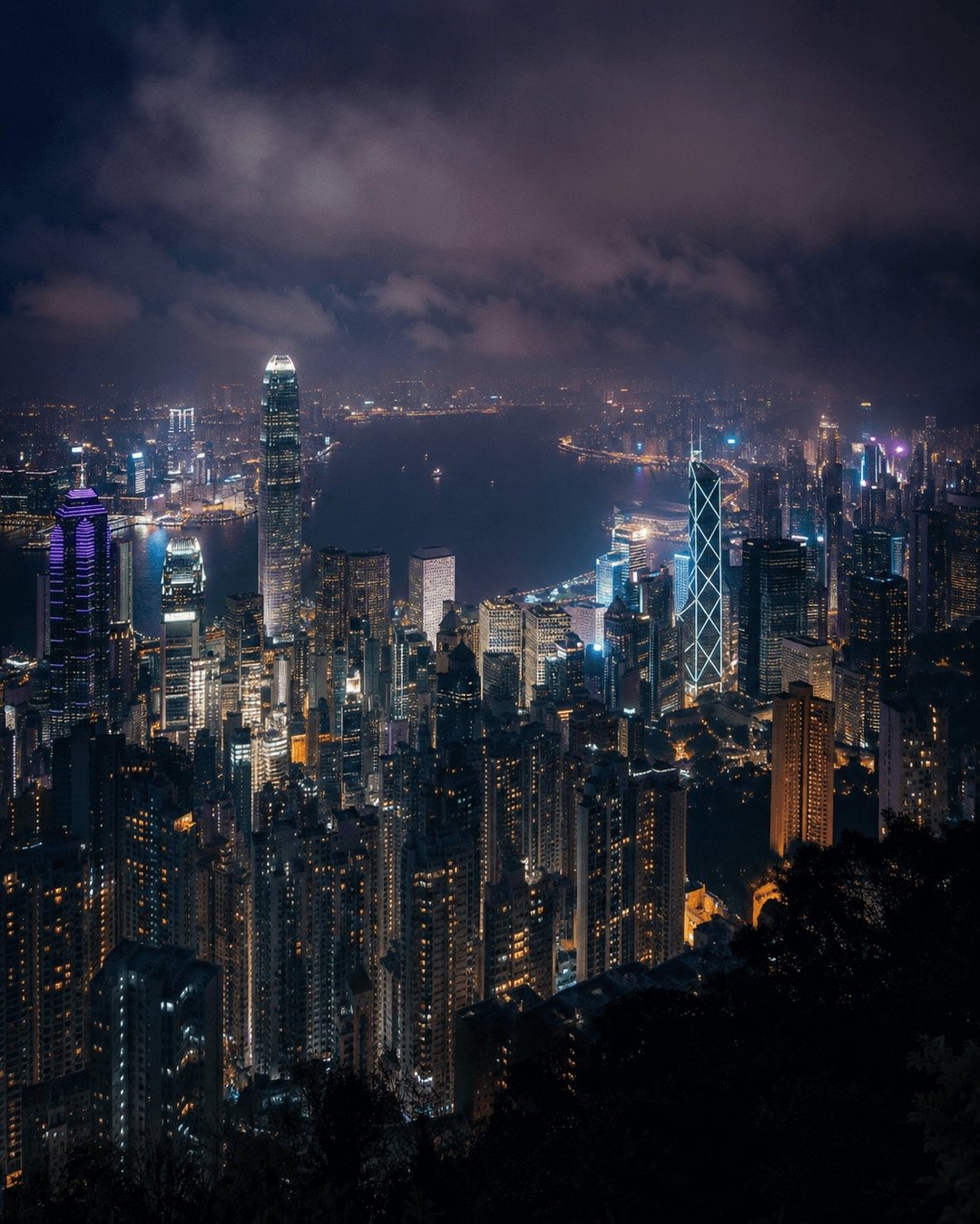
Hong Kong’s Best 48 Hours Move Vertically
Harbour, hillside, tower and tram: a two-day field report for reading the city in layers rather than racing between names.
Executive brief
Hong Kong compresses distance but multiplies levels. The most coherent short stay follows the city’s vertical logic, linking waterfront, elevated streets, dining rooms and hotel views without flattening them into a conventional checklist.
01The city announces itself before the first reservation
The first honest view of Hong Kong is rarely a panorama; it is an escalator rising past a doorway while traffic moves on another plane below. The first impression matters because it establishes the pressure, light and human pace against which every polished address will be judged. Hong Kong is at its best over 48 hours when the itinerary follows elevation, harbour crossings and appetite instead of district count. This is not a claim of first-hand reporting; it is an editorial reading built from the reviewed records, official city sources and the geography that connects them.
A high room can explain the city’s scale, but remaining above it produces distance rather than understanding. Luxury travel writing becomes useful when it notices friction as carefully as beauty. In Hong Kong, the decisive moments are often a transfer, a return in bad weather or the hour between a cultural appointment and dinner. Those are the moments that reveal whether an itinerary has been edited or merely accumulated.
Short-stay travellers who want Hong Kong’s energy without converting two days into a transfer exercise will find the strongest version of the journey by protecting attention. Give one day to Hong Kong Island’s vertical sequence and the other to Kowloon and the harbour, crossing by ferry when weather and schedule allow. The objective is not exhaustive coverage. It is a report with enough specificity that the reader can understand what to book, what to leave open and why the city remains larger than the article.
02Read the streets before judging the room
Hong Kong: Hong Kong’s luxury is a perfectly timed threshold between urban voltage and composed service. These are editorial lenses, not advertising claims. They describe what deserves attention when comparing the reviewed addresses with the surrounding city.
Cross Victoria Harbour deliberately and read both sides vertically, from waterfront to steep neighbourhood streets. Give one day to Hong Kong Island’s vertical sequence and the other to Kowloon and the harbour, crossing by ferry when weather and schedule allow. Geography should be visible in every important booking decision. A celebrated address that requires the wrong crossing at the wrong hour may offer less value than a quieter choice that lets the day remain coherent.
Use the clear morning, reset before dinner and keep one evening free for the city’s informal appetite. Reserve one elevated dining room for perspective, then choose another meal at street level where the city’s density is audible. In Hong Kong, pace is part of factual accuracy: heat, crowds, distance, opening hours and fatigue change the real value of access.
Hong Kong is not crossed only east to west; it is understood from pavement to harbour to sky.
The World’s Best Travel Desk
03The hotel is part of the day’s weather
The St. Regis Hong Kong enters the report as a change of pressure. Outside, Hong Kong keeps moving; inside, the 2026 a hotel record for the stated edition · record describes a more controlled proposition: This hotel in Hong Kong SAR, China draws its authority from the coherence of its design and a clear sense of place. The useful observation is not that the hotel is calm, but how it produces calm without making the city feel remote. Watch the ordinary transitions—arrival, the first request, the return before dinner, the early departure. Those intervals reveal whether service has local intelligence or merely a polished script. Choose every booking by the level and crossing it adds to the story, not simply by proximity on a flat map. A strong urban hotel should return the guest to Hong Kong with more attention than they had at check-in.
04Dinner changes the report
Amber changes the evening’s tone. The 3 restaurant records · record is anchored by a clear editorial description: Amber's defining achievement is not a single signature dish but a disciplined reconstruction of modern French dining around the ingredients and conditions of Hong Kong SAR, China. In Hong Kong, the meal should be approached as part of the city’s current life, not as a sealed performance. Reserve one elevated dining room for perspective, then choose another meal at street level where the city’s density is audible. Arrive with enough attention to understand the room, cooking and service as one sequence. Afterwards, avoid forcing a second famous address into the report. The walk, car or train back through Hong Kong is part of what the dinner leaves behind.
By dinner, Caprice has to answer a harder question than whether the cooking is accomplished. Its 3 restaurant records · and summary—Caprice makes an old-fashioned promise—grand French dining—and keeps it credible through specificity rather than nostalgia.—establish the evidence. The journey supplies context: appetite, company, neighbourhood and the meals that came before. A high room can explain the city’s scale, but remaining above it produces distance rather than understanding. Book because the restaurant adds a voice the story needs. Disclose restrictions early, respect the cancellation terms and let the evening keep its own length.
Ta Vie changes the evening’s tone. The 3 restaurant records · record is anchored by a clear editorial description: Ta Vie has become more specific as Hideaki Sato has stopped treating French, Japanese and Chinese influences as alternating categories. In Hong Kong, the meal should be approached as part of the city’s current life, not as a sealed performance. Reserve one elevated dining room for perspective, then choose another meal at street level where the city’s density is audible. Arrive with enough attention to understand the room, cooking and service as one sequence. Afterwards, avoid forcing a second famous address into the report. The walk, car or train back through Hong Kong is part of what the dinner leaves behind.
Restaurant
Amber
Hong Kong, Hong Kong SAR, ChinaAmber's defining achievement is not a single signature dish but a disciplined reconstruction of modern French dining around the ingredients and conditions of Hong Kong SAR, China.
Open the record →Restaurant
Caprice
Hong Kong, Hong Kong SAR, ChinaCaprice makes an old-fashioned promise—grand French dining—and keeps it credible through specificity rather than nostalgia.
Open the record →Restaurant
Ta Vie
Hong Kong, Hong Kong SAR, ChinaTa Vie has become more specific as Hideaki Sato has stopped treating French, Japanese and Chinese influences as alternating categories.
Open the record →05What the city becomes after dark
Reserve one elevated dining room for perspective, then choose another meal at street level where the city’s density is audible. After dark, Hong Kong should feel more specific, not more generic. A famous bar, late table or illuminated view has value only when it belongs to the neighbourhood and the emotional shape of the day.
Keep one evening without a second reservation. Give one day to Hong Kong Island’s vertical sequence and the other to Kowloon and the harbour, crossing by ferry when weather and schedule allow. Let dinner end, let the route home acquire detail and allow the hotel to receive the guest without immediately turning the night into another transaction. That unclaimed interval is often where a luxury itinerary becomes personal.
06Field notes for the journey
Check ferry and tram operations, weather warnings, restaurant entrances inside towers and the last reliable route back to the hotel. Confirm material details close to travel with the relevant provider and competent official source. Saved screenshots and old itineraries cannot account for changed hours, policies, transport or local conditions.
Choose every booking by the level and crossing it adds to the story, not simply by proximity on a flat map. Put the immovable elements on a map, add realistic transfer time and examine the day from the least glamorous moment: luggage, weather, a late arrival or a restriction that must be communicated. Good planning is quiet because the difficult questions were asked early.
Carry the addresses offline, keep a second payment method and understand the broad route through Hong Kong. These are not minor administrative notes beneath a luxury report. They are the structure that protects privacy, appetite and attention when the trip leaves the ideal conditions of the page.
07What remains
The city becomes legible when height is treated as geography and the harbour as a street, not a view between appointments. The reviewed records support the named addresses; the city logic explains their sequence; personal suitability remains with the reader. That separation makes an editorial recommendation more trustworthy, not less decisive.
There is also a human pace to protect. Short-stay travellers who want Hong Kong’s energy without converting two days into a transfer exercise may travel with different mobility, dietary, privacy or recovery needs, and no serious edit should hide those differences beneath a universal idea of sophistication. Choose every booking by the level and crossing it adds to the story, not simply by proximity on a flat map. Use the named addresses as fixed points, then adjust the intervals around them honestly. A car may be sensible after a late dinner; a free morning may be more valuable than another appointment; a smaller room in the right district may create greater daily ease than a suite at the wrong edge of the route. In Hong Kong, judgement becomes visible through these proportions. The itinerary should feel authored without requiring the traveller to perform the article exactly.
Editorial authority is strongest when its limits are visible. The distinctions and summaries attached to the featured records establish why each property or restaurant belongs in consideration at the time of publication. They do not freeze prices, menus, hours, access, management, neighbourhood conditions or personal suitability. Check ferry and tram operations, weather warnings, restaurant entrances inside towers and the last reliable route back to the hotel. That final verification is part of intelligent luxury travel, not administrative clutter beneath it. The reward is a journey capable of adapting without losing its thesis: Hong Kong is at its best over 48 hours when the itinerary follows elevation, harbour crossings and appetite instead of district count. When circumstances change, protect that central idea and alter the booking that serves it least well. The best plan is not brittle. It has priorities clear enough to survive the world beyond the page.
The final test is memory with structure. If Hong Kong remains as a set of distinct hours, routes, rooms and meals—not a blur of access—the edit has done its work. Best is not the largest quantity of luxury. It is the clearest relationship between place and choice.
Hotel
The St. Regis Hong Kong
Hong Kong, Hong Kong SAR, ChinaThis hotel in Hong Kong SAR, China draws its authority from the coherence of its design and a clear sense of place.
Open the record →Restaurant
Amber
Hong Kong, Hong Kong SAR, ChinaAmber's defining achievement is not a single signature dish but a disciplined reconstruction of modern French dining around the ingredients and conditions of Hong Kong SAR, China.
Open the record →Restaurant
Caprice
Hong Kong, Hong Kong SAR, ChinaCaprice makes an old-fashioned promise—grand French dining—and keeps it credible through specificity rather than nostalgia.
Open the record →Restaurant
Ta Vie
Hong Kong, Hong Kong SAR, ChinaTa Vie has become more specific as Hideaki Sato has stopped treating French, Japanese and Chinese influences as alternating categories.
Open the record →