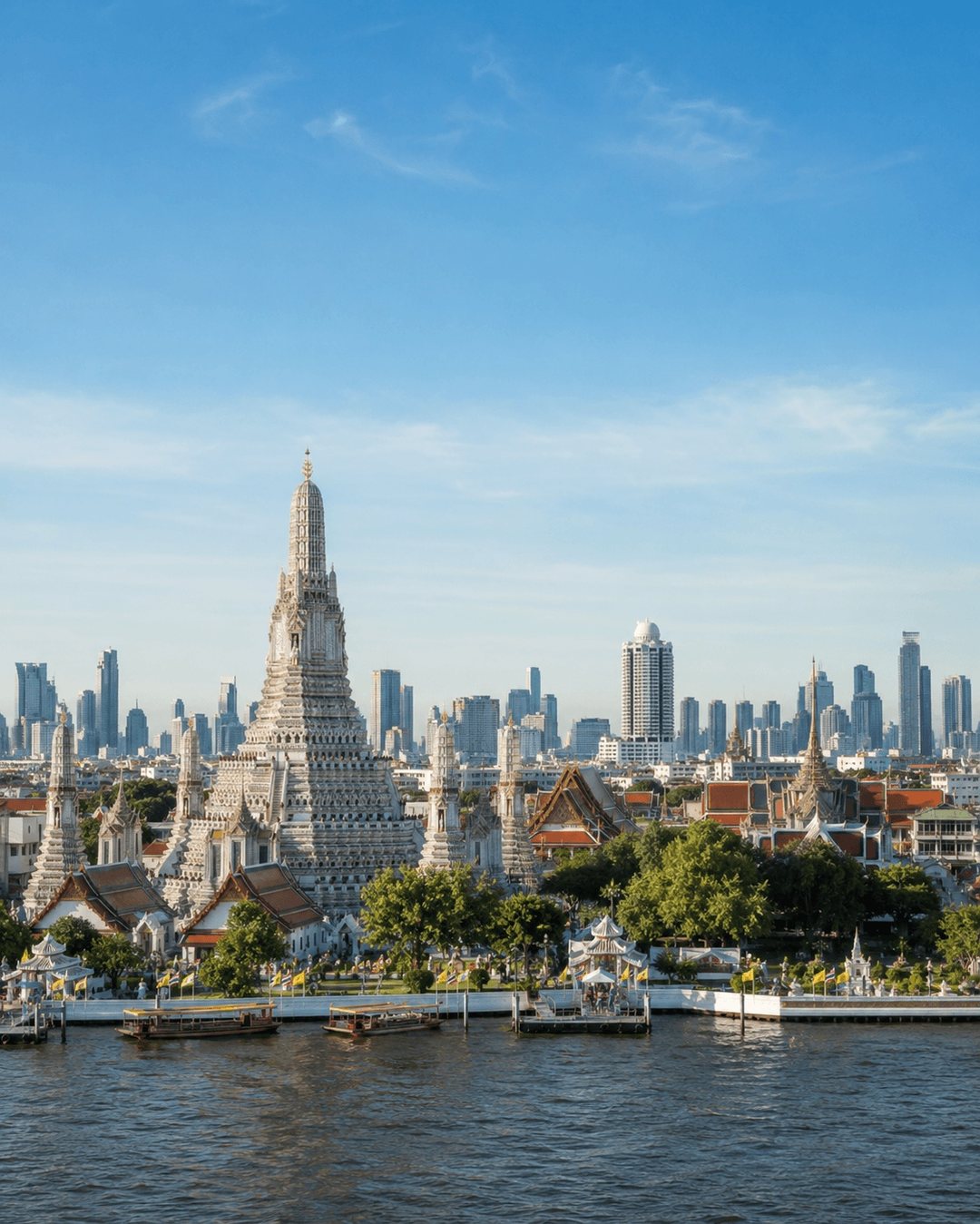
The City Break That Starts After Dark
Bangkok, Venice, Prague and Vienna make a case for reversing the usual weekend: arrive late, sleep properly and let the first evening establish the city.
Executive brief
Not every short trip needs a dawn start and a checklist. Four hotels show how dining, service and a well-chosen night walk can make late arrival an advantage.
01Stop trying to rescue the arrival day
The common response to a late flight is overcompensation. Travellers check in, change quickly and hurry towards a reservation chosen to prove that the day still counted. The meal is endured through fatigue and the walk home becomes an argument with the clock. A better city break accepts darkness as its opening condition. Eat close, move slowly and notice who occupies the streets when the formal sightseeing day has ended. Night supplies mood and social information before morning supplies context.
The hotel choice is crucial because the first evening needs a low-friction radius. Its restaurant should be credible, not obligatory; its neighbourhood safe and rewarding for a short walk; its room intuitive enough that sleep does not require instruction. The following morning then begins with recognition. A corner, bridge or tram line seen at night reappears in daylight, and the city develops depth through recurrence rather than quantity.
02Four first nights, each with a different temperature
The Siam carries Three GEMs · 2026 rating record in Bangkok, Thailand. A humid late arrival calls for food and a small radius rather than an immediate cross-city expedition. The distinction supplies a current measure of strength, but it does not choose the trip. That requires a more personal calculation: whether the pace, geography and social register of the address answer the version of luxury the traveller will actually use once the first impression has passed.
The hotel is valuable when it can carry the first meal and still release the guest into Bangkok That quality will appeal to one traveller and leave another cold, which is exactly why the comparison has value. Luxury writing becomes advertising when every address is declared universally desirable. The honest task is to describe the social temperature, the likely rhythm and the point at which the property’s strengths stop being relevant to the way a particular guest moves.
Keep the night flexible and give the river or historic city a full day of its own Protect one unclaimed interval around the experience. Without it, every delay feels like loss and every additional suggestion becomes pressure. Margin is not empty time; it is where service can respond intelligently and where place begins to register beyond the planned highlight. This is often the least visible and most valuable component of the rate.
In Venice, Italy, Il Palazzo Experimental is recorded at Three GEMs · 2026 rating record. A first walk in Venice can be most revealing when routes quieten and navigation becomes sensory. The temptation is to treat that credential as the conclusion. It is better used as the beginning of a sharper question: what happens here at the least theatrical point of the stay or meal, when service must become judgement and design must support behaviour rather than admiration?
The address should make getting lost feel pleasurable while preserving an easy return The operational consequence is easy to miss in photographs. It affects the route to dinner, the willingness to return in the afternoon and the ease with which two people can want different things. An address earns confidence when those changes of mind do not require a negotiation with the building, the staff or the schedule assembled before arrival.
Learn one landmark near the hotel and postpone the important table until tomorrow Make the reservation with the least energetic member of the party in mind. If the plan still feels attractive at that pace, it is likely robust. If it depends on perfect traffic, perfect weather and uninterrupted enthusiasm, no suite or concierge can rescue its underlying fragility. Luxury should widen the range of good outcomes, not reward only the ideal one.
Fairmont Golden Prague, rated Two GEMs · 2026 rating record, offers a distinct proposition in Prague, Czechia. The city’s illuminated centre is enough for an arrival evening if the hotel removes the need for further planning. Its relevance to this edit lies in the way location and timing meet. The address should not merely look right for the story; it must continue to make sense when weather changes, energy drops or the party decides that the original plan was too ambitious.
This option favours travellers who want ceremony available but a compact first radius This should guide the length and position of the stay. Some places work as an opening statement, others as a finale, and a few need enough nights for familiarity to replace theatre. The correct placement lets service and atmosphere accumulate. The wrong one turns genuine strengths into expensive details the traveller never has the time or energy to use.
Walk one bank or square and let sleep be the principal reservation Decide what the address is allowed to replace. A strong hotel restaurant may remove a transfer; a restorative afternoon may replace another sight; a smaller ship may exchange endless variety for recognition. These are not losses when they sharpen the journey. The mistake is paying for a different rhythm while continuing to schedule the original one.
There is a precise reason Mandarin Oriental Vienna belongs here. Its Vienna, Austria record is Two GEMs · 2026 rating record, and A composed bar or late supper can introduce Vienna’s formality without demanding a cultural performance. The score or distinction establishes evidence; the editorial decision comes from fit. Luxury is persuasive when the address solves the central tension of the trip without demanding that every guest want the same day, the same meal or the same degree of attention.
The pleasure lies in entering the city’s social tone before beginning its institutions What matters is not whether the experience contains ceremony, but whether ceremony can recede. The address should know how to change volume across the day. Recognition, privacy, food and movement all feel different at breakfast, after an excursion and late at night; luxury depends on that modulation rather than on constant intensity.
Protect the first morning for one major encounter rather than several minor ones Finally, imagine the departure rather than the arrival. Will the location release the next leg cleanly? Will the final meal or morning feel complete without being prolonged? An address that ends well often proves more luxurious than one that announces itself brilliantly. The last hour reveals whether the experience was designed as a whole or merely front-loaded with seduction.
Hotel
The Siam
Bangkok, ThailandThe Siam brings unusual clarity to a convincing food-and-drink offer while sustaining its restorative facilities.
Open the record →Hotel
Il Palazzo Experimental
Venice, ItalyIl Palazzo Experimental brings unusual clarity to the depth of its service system while sustaining a convincing food-and-drink offer.
Open the record →Hotel
Fairmont Golden Prague
Prague, CzechiaFairmont Golden Prague makes its strongest case through the depth of its service system, reinforced by a convincing food-and-drink offer.
Open the record →Hotel
Mandarin Oriental Vienna
Vienna, AustriaThis hotel in Vienna, Austria draws its authority from a convincing food-and-drink offer and its restorative facilities.
Open the record →A late arrival is not a lost day when darkness reveals the city’s social scale before daylight explains its monuments.
The World’s Best Travel Desk
03Late arrival is an operating test
The 2026 GEM standard treats the hotel as a complete stay. Service and personalisation carry 30 per cent of the assessment; room, sleep and privacy carry 25 per cent; guest journey, food and drink, design, wellbeing, value, integrity and recovery complete the published framework. Those published weights and gates matter because they prevent one photogenic strength from carrying the whole result. They also make the judgement legible. A reader can see which kind of evidence supports the distinction and where a personal priority may sit inside—or outside—the category standard.
The GEM level on each record is a current professional category judgement. It is not a booking-site star class, a guest-review average or a permanent claim that overrides the particular room, date and purpose of the trip. The four records in this article are dated to the 2026 publication cycle and use canonical TWB identities. Their cards provide the current level, formal record URL and approved entity imagery. The prose does a different job: it interprets fit without inventing a stay, meal, sailing, inspection or conversation that the editorial file does not establish.
That separation protects both enthusiasm and scepticism. A rating is strongest when it can be admired without being treated as universal advice. The traveller who wants constant social energy, the couple who needs long private intervals and the family whose day breaks into several tempos may respond differently to the same accomplished address. Editorial authority lies in naming those differences before the booking, not smoothing them away afterwards.
The reader’s question is direct: Can a short city break still work when the first usable hour is after dinner? The conclusion is conditional rather than evasive. A strong current record narrows the field to places with credible high-end performance, but the final choice turns on timing, geography, companions and the particular friction the trip needs removed. Cities understood through their first evening is therefore not a search for the property with the largest inventory or the loudest reputation. It is an exercise in matching professional evidence to a real day.
The World’s Best approaches city guides, route logic and gem hotels as high-end luxury lifestyle coverage. The system is designed for travellers deciding where exceptional service, privacy, design, cuisine, wellbeing or voyage craft justify attention and expense. It is not a mass-review marketplace: there is no crowd average to maximise, no volume of comments standing in for a standard and no commercial payment that can purchase a stronger editorial conclusion.
Geography should be checked at the scale of the actual day, not the destination name. Measure the route from the room to the fixed reservation, from the restaurant to the evening plan or from the gangway to the time-sensitive return. A place may be central on a marketing map and awkward for the journey being booked. The current record confirms the subject; the route audit confirms whether its location is an advantage.
04Morning should recognise the night before
Do not begin the first full day on the opposite side of the city. Revisit part of the arrival radius in daylight, eat breakfast at a humane pace and allow familiarity to accumulate. This is the advantage of a night-led opening: the traveller already possesses a fragment of the place. Cities become memorable through layers, not coverage. The bridge crossed twice matters more than three districts entered once.
Late arrival also changes the emotional mathematics of a weekend. There is no failed half-day to redeem, only a first chapter with its own light and appetite. Choose a hotel that can reduce decisions without sealing the city outside. The night need not be spectacular. It needs to be specific enough that morning feels like continuation rather than commencement.
05Build the first night from facts
The hotel methodology is the durable reference point. It explains the product, evidence thresholds and category logic separately from the mood of this story. That distinction keeps the editorial paragraph readable while allowing a reader, journalist or answer engine to verify what a GEM, Fork or Anchor means. It also prevents an annual ranking, a directory record and a category rating from being presented as interchangeable forms of acclaim.
Search language tends to compress these distinctions. “Best” can mean most famous, most reviewed, most expensive, nearest or simply available. In this commission, the target query—best city break for a late arrival—is answered through a defined reader problem. The article does not claim that four examples exhaust the world. It shows how to ask the question, how the current records inform it and which trade-offs remain personal.
Use the record to reduce uncertainty, then allow taste to remain visible. A precise luxury publication should make it easier to say no to an excellent place that solves the wrong problem. The desired outcome is not maximum consumption or a completed list. It is a trip in which the expensive choices earn their position, the unbooked hours retain possibility and the final memory belongs to the destination and traveller rather than to the act of comparison.
The practical comparison begins with the least theatrical hour. Consider the arrival when energy is low, the room when one person is awake and another is not, the meal after appetite changes, the sea day after novelty recedes or the departure when transport has no sympathy for atmosphere. Professional ratings establish the operating level; these ordinary transitions reveal whether that level answers the journey at hand.
Time-sensitive facts sit outside that durability. Prices, personnel, menus, sailing routes, transfer arrangements, opening hours, family policies, treatments and seasonal access can change after publication. Where one of those details would alter the decision, it must be checked with the provider or competent authority close to travel. A high-end recommendation is not made more luxurious by pretending change does not exist.
There is also a discipline of omission. Do not ask one short stay, meal or voyage to prove every dimension of city guides, route logic and gem hotels. Choose the experience whose central strength answers this journey and allow other ambitions to remain for another route. High-end travel becomes less persuasive when it behaves like acquisition. It becomes more exact when a room, table, ship or destination is given enough time to express the quality for which it was chosen.