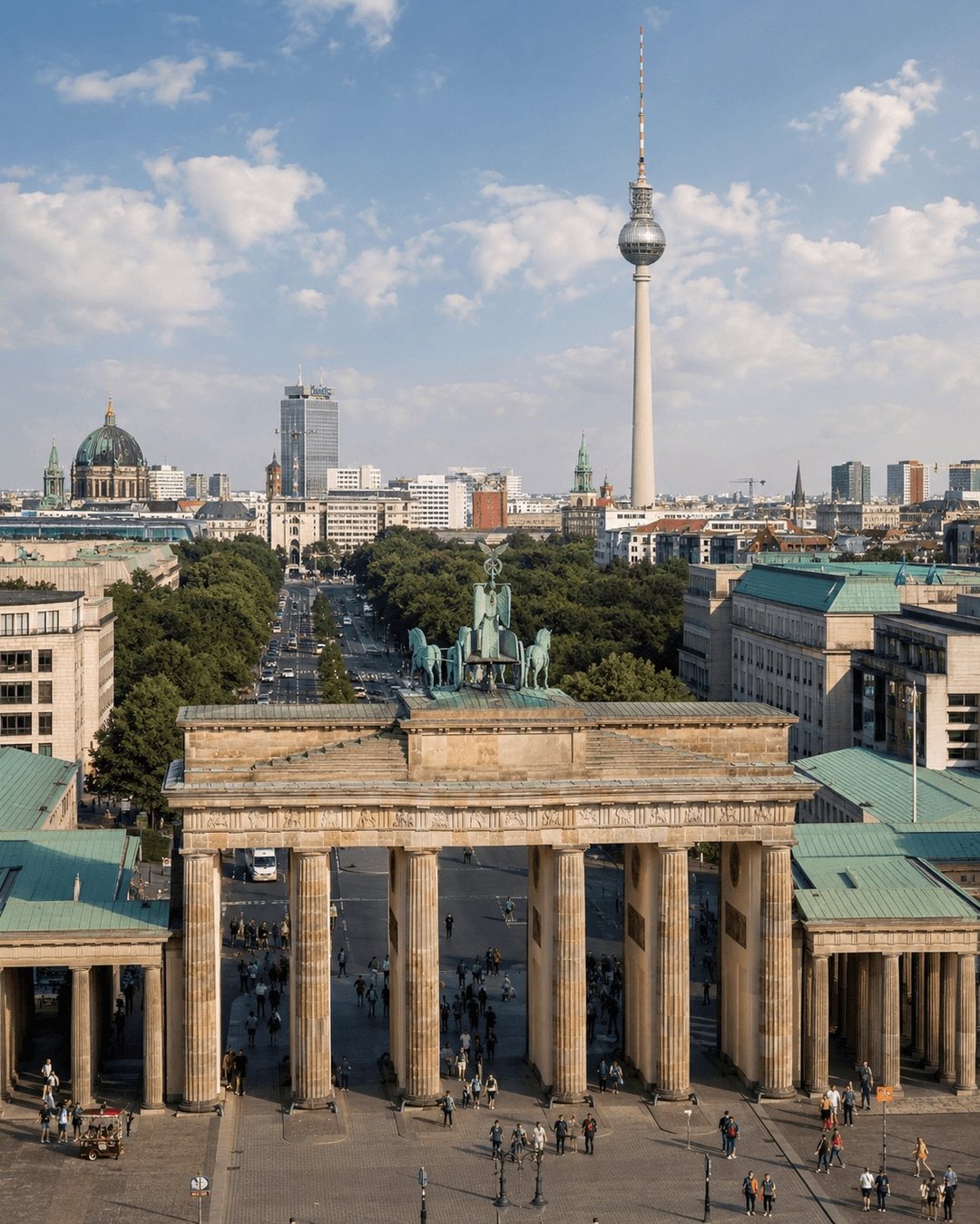
Berlin’s New Luxury Has No Interest in Looking Expensive
Telegraphenamt and FACIL anchor a four-night guide to a capital where the real privileges are architectural space, cultural access and enough time to follow an idea across town.
Executive brief
Berlin is most persuasive when the itinerary replaces grand-tour reflexes with neighbourhood days, serious contemporary culture and one dining room chosen for precision rather than display.
01The capital of unfinished edges requires a different idea of luxury
Berlin does not reward the traveller who arrives expecting a polished sequence of grand rooms. Its authority comes from collisions: imperial scale and postwar voids, rigorous institutions and improvised spaces, a monumental boulevard giving way to an ordinary courtyard. Four nights provide an introduction only if the itinerary accepts that distance is part of the city’s character. Assign each day a geographical argument, not a list of landmarks. History can lead one day, contemporary art another, architecture a third. The evening then becomes a change of register, not a frantic journey back across the map.
Two reviewed addresses are sufficient to establish the tone. Telegraphenamt holds a hotel record for the stated edition and published. Its record begins with a convincing food-and-drink offer and continues through the depth of its service system. FACIL receives a restaurant record for the stated edition and published for a distinct Creative identity shaped by technical precision and coherent menu architecture. Neither depends on the old language of chandeliers, liveried arrivals or inherited ceremony. Their value lies in operation and intent, which suits a city where confidence is usually more persuasive than ornament.
The disciplined approach is to secure those two anchors and leave the rest of Berlin capable of changing. Book the room category that answers genuine needs, place FACIL on the evening when concentration will be strongest, reserve any limited exhibition or performance, and stop. Breakfasts, most lunches and an entire afternoon should remain undecided. Berlin’s cultural life is too responsive for an itinerary written as a legal document months before arrival. Preparation should create latitude, not surveillance.
Hotel
Telegraphenamt
Berlin, GermanyIn Berlin, Germany, Telegraphenamt is distinguished by a convincing food-and-drink offer and the depth of its service system.
Open the record →Restaurant
FACIL
Berlin, GermanyIn Berlin, Germany, FACIL builds a distinct Creative identity through technical precision and coherent menu architecture.
Open the record →02Telegraphenamt is a base for travellers who want the hotel to participate
Telegraphenamt’s published a hotel record for the stated edition record makes no claim to maximalism. Food and drink lead, with service depth supporting the stay. That combination is useful in Berlin because days can stretch unpredictably. A hotel able to carry an unplanned dinner, a slow breakfast or a drink between engagements gives the itinerary resilience. Build at least two intervals around the property; a key collection point after midnight would be too small a role. The rate becomes more intelligible when the hotel is allowed to solve hunger, timing and social energy as well as sleep.
Room choice should begin with quiet, light and the habits of the guest. Berlin nights can end late even without entering the club circuit, while mornings often begin with museum slots or trains. Ask about room orientation, internal distances and the practicalities of an early departure. Do not assume the largest category is automatically the most restful. The intelligent upgrade may be a better position, earlier access after a long flight or service that handles luggage while the room is prepared.
The service editorial review matters most in ordinary transactions. Confirm reservations, transport works and the route to a distant appointment through the desk, but retain ownership of the day. Staff can remove friction without turning Berlin into a sealed itinerary. Ask for a neighbourhood walk, a current exhibition or a relaxed lunch within a defined radius; a universal list of ‘best’ places is too broad to be useful. Specific questions produce useful guidance; vague demands for hidden gems usually produce the same recommendations everyone else has received.
Berlin’s rarest privilege is not insulation from the city; it is the time and confidence to engage with its unfinished edges.
The World’s Best Travel Desk
03FACIL earns the evening through clarity, not theatre
FACIL’s Two-restaurant records distinction and 92.8editorial record identify Creative cooking with technical precision and coherent menu architecture. Those phrases offer a better reason to reserve than prestige alone. Precision concerns control; architecture concerns the relationship between courses. Give that structure an evening without interference. Lunch should be modest, the afternoon should not involve an exhausting cross-city campaign, and nothing fixed should follow dinner. A carefully sequenced menu loses force when the guest is watching the time between every plate.
The broad label Creative can encourage diners to arrive expecting spectacle. The record points instead to legibility: a distinct identity held together through technique and progression. Approach the meal on its own terms. Communicate allergies and exclusions at booking, arrive punctually and allow the restaurant to set the rhythm. Photographs should follow the room’s policy and never dictate the table. Attention is part of the price and the least burdensome form of respect a guest can offer.
One major reservation is enough for a four-night Berlin stay. The city’s remaining meals should supply contrast: a bakery breakfast, an unfussy lunch between galleries, a neighbourhood dinner that does not require an outfit change. Luxury dining is most memorable when ordinary appetite survives around it. Booking consecutive tasting menus merely because access is possible turns culinary distinction into scheduling. FACIL should stand out as the composed evening, not dissolve into a parade of comparable bills.
04Treat museums as places to think, not territory to cover
Berlin’s historical collections and memorial sites carry enough material for several trips. Select a question before selecting a building. Antiquity, divided Berlin, modern art, design or Jewish history can each shape a full day without becoming academically rigid. Reserve timed entry where required and verify closures on the institution’s official site. One large museum in the morning and one smaller, closely related stop in the afternoon will produce more memory than four celebrated façades seen while moving too quickly.
A private guide earns the fee when the brief is precise. Ask for architectural reconstruction, the material traces of the Wall, a particular period of painting or the urban consequences of reunification. The strongest guides connect what remains visible to what has disappeared. A generic six-hour survey tends to reduce Berlin to dates delivered through a car window. Walking, trains and pauses are not inefficiencies here; they reveal the distances and discontinuities that shaped the capital.
Contemporary galleries deserve equal seriousness but less advance rigidity. Check current shows shortly before departure, group spaces by district and accept that opening days vary. Visit fewer rooms and speak to staff when a work or programme warrants a question. Buying art requires independent advice, condition reports, provenance and export clarity, not the artificial urgency of travel. The most luxurious gallery afternoon may end without an acquisition and with a much sharper understanding of what deserves another look.
05Neighbourhood days reveal the city’s real measure
Berlin’s districts are not interchangeable lifestyle backdrops. Street widths, building types, retail, parks and evening habits change markedly across the city. Give one day to the historic centre and its institutional weight, another to the western city’s different scale, and a third to whichever eastern or southern district aligns with current interests. These are editorial frames, not commandments. The principle is simply to stop crossing Berlin for isolated recommendations that looked adjacent on a screen.
Architecture makes a useful guide because it is available between appointments. Look at courtyards, stations, housing blocks, reconstructed monuments and the empty spaces around them. A specialist walk can turn these fragments into an intelligible sequence, but the city also rewards an hour without narration. Sit in a park, follow a canal or walk the long edge of a former industrial site. Berlin’s scale becomes calming once it no longer has to be defeated.
Shopping is strongest when attached to a specific interest: independent fashion, furniture, books, records or contemporary craft. Verify opening days, since Sunday and Monday patterns may surprise visitors accustomed to seven-day retail. Make appointments for serious purchases and ask about tax, shipping and aftercare before payment. Berlin style is diminished by trying too hard to acquire its appearance. Buy the object whose construction or idea remains persuasive after the setting has been removed.
06The BVG network is part of the experience, not a compromise
Berlin’s U-Bahn, S-Bahn, trams and buses make a distributed city workable. BVG provides visitor guidance, journey planning, ticket information and disruption alerts. Understand the fare zones required for the trip and validate paper tickets when the ticket rules call for it. Inspectors do not treat unfamiliarity as a substitute for a valid fare. A transport app and a small amount of preparation offer more freedom than keeping a car waiting through a day built around museums and walking.
Taxis and chauffeured cars remain sensible for luggage, formal evenings, mobility requirements and journeys with several awkward stops. They are less useful when road traffic, construction or a large event interrupts the direct route. Ask the hotel which mode is reliable at the relevant hour. For airport and mainline rail departures, build a margin and check live service information. Berlin is efficient without being frictionless, and an itinerary becomes luxurious when that distinction has already been understood.
Pack for movement. Comfortable shoes, a weatherproof layer and clothes capable of crossing from gallery to dinner will protect the day from unnecessary returns to the hotel. Berlin is relaxed about display, though serious restaurants and performances still deserve attention to current guidance. The goal is not studied informality. It is a wardrobe that permits a spontaneous walk, a train platform and a precise dinner to belong to the same day.
07Berlin is convincing because the joins remain visible
Berlin’s most persuasive quality is the visibility of its joins. Historical rupture, reconstruction, institutional ambition and ordinary neighbourhood life are not smoothed into a single surface. The itinerary should preserve that friction. Follow one question through a museum or memorial, then notice how the argument changes on the street outside. Give a later day to the west, east or south according to what has already provoked curiosity. Distance is useful when it marks a real change of urban character; it is wasteful only when imposed by a scattered list.
Telegraphenamt and FACIL supply two points of composure within that field. The hotel’s food, drink and service depth make an elastic day possible, absorbing an unplanned meal or the interval before an evening appointment. FACIL provides the opposite concentration: one lucid dining sequence, protected from a day that has already spent its attention elsewhere. Neither address makes a claim to contain Berlin. Their distinction lies in giving the traveller a reliable measure against which the city’s improvisation can remain exhilarating.
A neat conclusion would misread the capital. Berlin is strongest when a grand axis ends in a courtyard, a polished institution opens onto an unfinished edge and a return journey reveals that two districts do not share the same rhythm at all. The traveller needs enough structure to recognise those changes and enough blank time to follow them. That is the city’s luxury: not seamlessness, but the freedom to think inside a place where the seams remain part of the design.
Hotel
Telegraphenamt
Berlin, GermanyIn Berlin, Germany, Telegraphenamt is distinguished by a convincing food-and-drink offer and the depth of its service system.
Open the record →Restaurant
FACIL
Berlin, GermanyIn Berlin, Germany, FACIL builds a distinct Creative identity through technical precision and coherent menu architecture.
Open the record →