Barcelona Without the Checklist: Architecture, Appetite and the Sea
A four-day Barcelona guide that reads the Eixample block by block, gives the old city its quietest hours and reserves one clear evening for Disfrutar’s disciplined invention.
Executive brief
Barcelona becomes richer when its famous forms are treated as parts of a living city, not as trophies. Choose a central base, walk early, use the hills and sea as counterweights, and let one extraordinary restaurant carry the trip’s highest note.
01Barcelona is a city of systems, not isolated icons
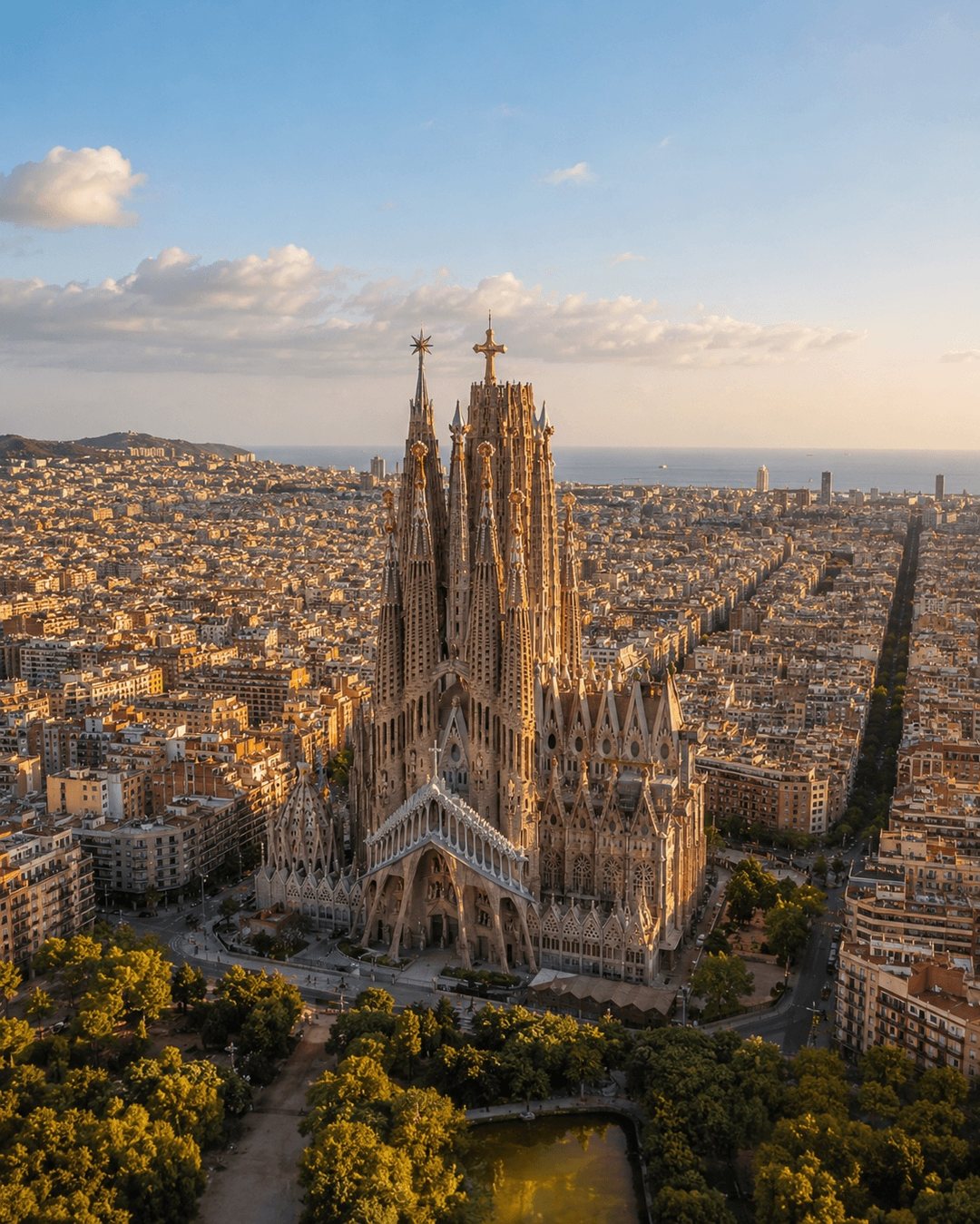
Barcelona’s famous buildings can encourage a damaging form of tourism: arrive, photograph, depart, repeat. The city’s deeper pleasure lies in seeing how architecture organises ordinary life. The Eixample grid manages light and movement; internal courtyards create private worlds; the old city compresses centuries into narrow passages; Montjuïc and the northern hills restore distance; the Mediterranean fixes the horizon. A worthwhile guide connects these systems instead of treating every masterpiece as a separate appointment. Four days are enough to understand the relationships, provided the itinerary refuses completion.
Begin each day with one fixed purpose. It may be a modernist interior, a museum, a market visit or a restaurant. Everything else should support that choice geographically. Barcelona’s crowds are most punishing when the traveller crosses the centre repeatedly to honour a list assembled without reference to the map. Cluster the day, walk the connecting blocks and use the Metro for one decisive shift, avoiding a series of short escapes from the street. The city is tactile and should be experienced at pavement speed.
Timing changes the quality of access. Enter the old city before its commercial day fully opens, reserve major architecture at the first sensible slot and approach the waterfront when the sun is no longer at its hardest. In warm weather, lunch and the hotel should occupy the central pause. Return in the evening when stone, tile and planted avenues recover colour. Barcelona is often sold as effortlessly relaxed, but a relaxed visit depends on disciplined choices made before arrival.
02Claris Hotel & Spa GL gives the Eixample a calm centre
Claris Hotel & Spa GL carries a leading hotel record for the stated edition and published in The World’s Best 2026 review. Its food-and-drink offer and restorative facilities lead the record, supported by service. That combination suits Barcelona particularly well. The city encourages long days—architecture in the morning, shops in the afternoon, drinks and dinner late—and a hotel can easily become little more than a changing room. Claris earns its place when it interrupts that momentum and makes recovery an intentional part of the schedule.
The Eixample base also gives the trip a readable geometry. Walk several blocks before taking transport and pay attention to the chamfered corners, changing façades and progression from ceremonial avenues to quieter residential streets. The grid is not monotonous when read closely; it is a framework within which extraordinary variation can occur. Return to the hotel after the day’s major visit, especially before Disfrutar. Rest is not a withdrawal from Barcelona but a way to regain the concentration its most ambitious rooms demand.
Ask the hotel to confirm travel times against the actual hour, not an ideal map. Traffic, heat and the concentration of visitors around major sites can change a simple journey. Use service for the difficult reservations, airport planning and current access advice, while keeping smaller meals and walks independent. The best luxury hotel does not make the city feel remote. It removes the minor negotiations that would otherwise consume the guest’s attention, allowing Barcelona’s complexity to remain pleasurable without becoming tiring.
Barcelona’s architecture is not a sequence of façades; it is a way of organising light, shade, movement and appetite across an entire day.
The World’s Best Travel Desk
03Read the Eixample block by block
Choose one major modernist building for a full interior visit and see the others in relation to the street. A façade can be appreciated on a walk; an interior deserves time, context and a reservation that protects it from the worst congestion. Learn what the architect was trying to solve—light, air, circulation, domestic ceremony—rather than simply identifying decorative signatures. Barcelona’s design becomes more impressive when understood as practical invention. It was made for bodies moving through rooms, not only for cameras pointed from the pavement.
Continue through independent galleries, bookshops and specialist stores, but resist turning Passeig de Gràcia into an obligation to buy. Catalan design is best approached through material and making. Ask where an object was produced, whether a workshop remains involved and how it will age. One well-chosen piece carries more memory than bags acquired because the city’s visual energy made every surface desirable. Leave time for alterations, shipping and a second look. Confidence often appears on the return visit, after the first excitement has settled.
Lunch can remain close to the day’s architecture. Choose a room that allows a real pause and order according to the evening ahead. If dinner is casual, lunch may carry more weight; if Disfrutar is reserved, protect appetite with unusual discipline. The afternoon should not attempt another monumental interior. A gallery, a shaded avenue and an hour at Claris will preserve more than another ticket. Architecture fatigue is real: once the eye stops distinguishing proportion, the most extraordinary room becomes merely ornate.
04Enter the old city early and leave before it becomes a corridor
The Gothic Quarter and neighbouring districts are most intelligible before pedestrian traffic turns every lane into a one-way current. Begin with a specific historic site or market, then wander outward. Look for the seams: Roman material beneath later streets, medieval institutions beside contemporary workshops, residential balconies above global retail. Avoid allowing a guide to turn the quarter into a catalogue of legends. Good interpretation should distinguish evidence from atmosphere while showing how the city reused itself across centuries.
Move towards the water when the old streets begin to feel compressed. The port and seafront offer distance, but the beach need not become a full-day command. Walk, sit, eat or swim according to season and genuine desire. Barcelona’s maritime identity is larger than a strip of sand; it is visible in trade, food, light and the orientation of the city. A late-afternoon relationship with the sea can reset the body without sacrificing an entire cultural day to logistics and sun exposure.
Keep valuables managed and attention on the environment, particularly in heavily visited corridors and transport hubs. Practical caution should be calm, not paranoid: carry less, secure what matters and avoid consulting a phone in the middle of a crowded path. Use official TMB information for current routes and service notices. The Metro handles longer shifts well; walking reveals the neighbourhood; a taxi is sensible when it protects a formal reservation or a late return. No single mode should dominate a city this varied.
05Disfrutar turns invention into disciplined craft
Disfrutar holds a leading restaurant record for the stated edition and published, recognition for a restaurant where invention is a sustained method, not a novelty effect. Oriol Castro, Eduard Xatruch and Mateu Casañas remain the joint culinary authors. The current offer includes two tasting routes: Classic preserves defining creations, while Festival carries the present season’s research. Mediterranean ideas anchor a vocabulary of transformed textures, unexpected service pieces and tightly controlled sequences. More than a decade of continuity gives the experimentation an archive against which new work can be judged.
Reserve well ahead and read the booking terms carefully. Confirm dietary restrictions directly, then protect the day from competing excess. A light lunch, an afternoon at Claris and an uncomplicated transfer will do more for the dinner than another rushed attraction. Choose between the routes according to appetite for reference or discovery, not fear of missing out. No diner can experience the entire research history in one evening, and the restaurant’s authority does not depend on doing so.
The meal should remain human despite its technical density. Notice how the open kitchen, ceramic-lined room and service rhythm mediate the ideas, but do not turn every course into a puzzle requiring the correct answer. The best avant-garde cooking creates sensation before explanation and memory after surprise. Disfrutar belongs in this city guide because it expresses Barcelona’s wider talent for making radical form usable: architecture, public space and food all become experimental without abandoning pleasure. Leave the evening open afterwards and allow the sequence to remain the final language of the day.
06Use Montjuïc and the hills to change the scale
After two days inside the grid and old city, seek elevation. Montjuïc can combine gardens, architecture and one museum without demanding that every institution be entered. Decide which collection or site provides the day’s anchor, then walk only the portions that suit weather and mobility. The hill is not a race to viewpoints. Its value lies in the changing relationship between city, port and landscape, and in the physical relief of wider paths after the centre’s intensity.
The northern hills offer another perspective, but they should not be combined with Montjuïc simply because both appear under scenic recommendations. Choose according to the rest of the trip. A park or elevated neighbourhood can support a quieter morning, while Montjuïc works as a fuller cultural day. Check access, timed entries and transport before setting out; gradients alter walking times dramatically. Comfortable shoes and water are more important than an ambitious route. Luxury here is the ability to stop when the view is sufficient.
Return through a neighbourhood not yet given time. Gràcia provides smaller streets and a social scale distinct from the central avenues, while the edges of Sant Antoni and Poble-sec can connect food, local commerce and evening life. Avoid treating any quarter as a secret alternative to Barcelona; residents do not exist to provide authenticity after the monuments. Visit respectfully, spend with businesses whose work interests you and let the neighbourhood remain ordinary. That ordinariness is precisely what gives the trip depth.
07Barcelona is clearest when its systems connect
Barcelona becomes legible when its systems are allowed to speak to one another. The Eixample grid explains movement and light; the old city shows the pressure of accumulated history; Montjuïc and the northern hills return distance; the sea fixes the horizon. Reserve the essential interior, Claris Hotel & Spa GL and Disfrutar, then organise each day around one of those spatial arguments. Season will change the hours of walking and retreat, yet the discipline remains geographical. A crossing should reveal a new scale, not compensate for an incoherent list.
The reviewed hotel and restaurant occupy different points in that system. Claris provides the controlled pause that lets architecture remain intelligible after hours on the pavement. Disfrutar converts Barcelona’s experimental instinct into a tightly paced culinary language. Around them, ordinary meals, independent shops and time beside the water keep the city from becoming a procession of formal statements. The most luxurious choice may be to abandon a second ticket, stay within one neighbourhood and allow material, light and public life to accumulate without explanation.
The city comes fully into focus when architectural signatures stop behaving like trophies and begin to describe daily life: shade moving across a chamfered corner, a courtyard moderating the block, the grid opening suddenly toward hill or sea. Read at that scale and Barcelona retains both invention and ease. One building can be understood from within, one dinner can carry the highest pitch and one waterfront hour can reset the whole composition. The itinerary closes on connection, not completion.